Boosting Wi-Fi, supporting special needs, and wraparound services: Delawareans share priorities for COVID-19 educational needs

As Delaware and the world continue to respond to the effects of the COVID-19 pandemic, Delawareans identified Wi-Fi solutions for students as one of the key short-term education relief priorities.

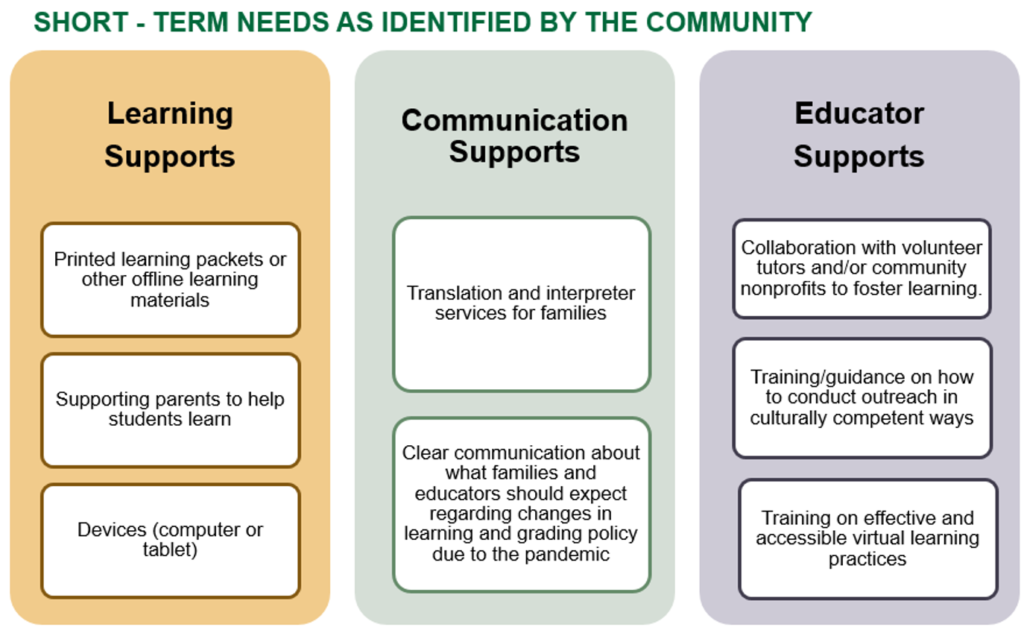
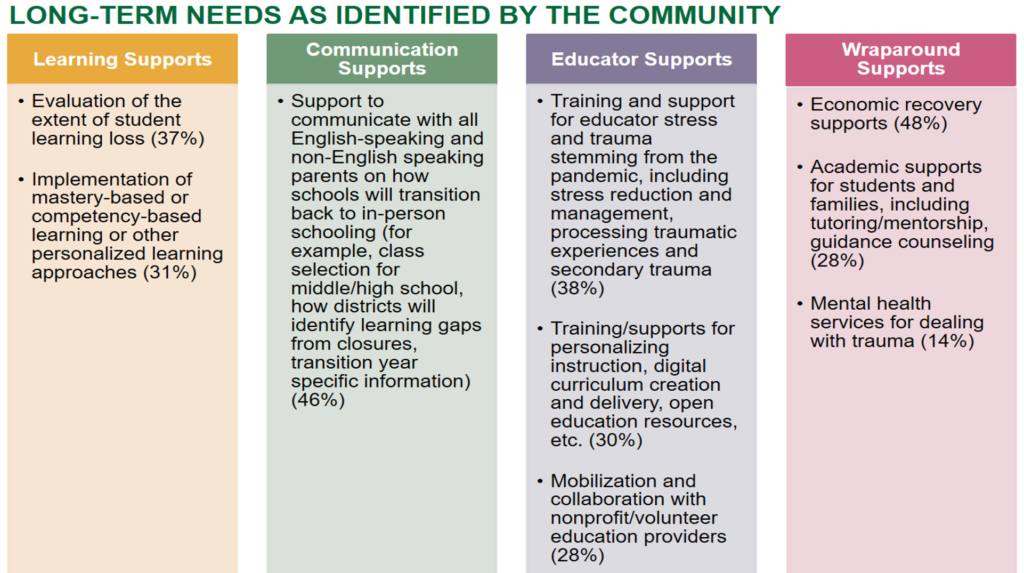
In a survey conducted by Rodel, 859 Delawareans prioritized the immediate, short-term needs in the wake of COVID-19, as well as the longer-term needs for when students and teachers resume class. Respondents gave insights into categories such as student learning, family communication, educator support, and wraparound/non-instructional services.

Among the most critical needs, respondents recommended:

  • Wi-Fi/broadband infrastructure to support remote learning (53% response)
  • Clear communication to families and educators about what to expect and how to navigate the crisis (53% response)
  • Guidance and support to meeting specific special learning needs for students, such as Individualized Education Program (IEPs) and translation services for non-English speaking families (50% response)
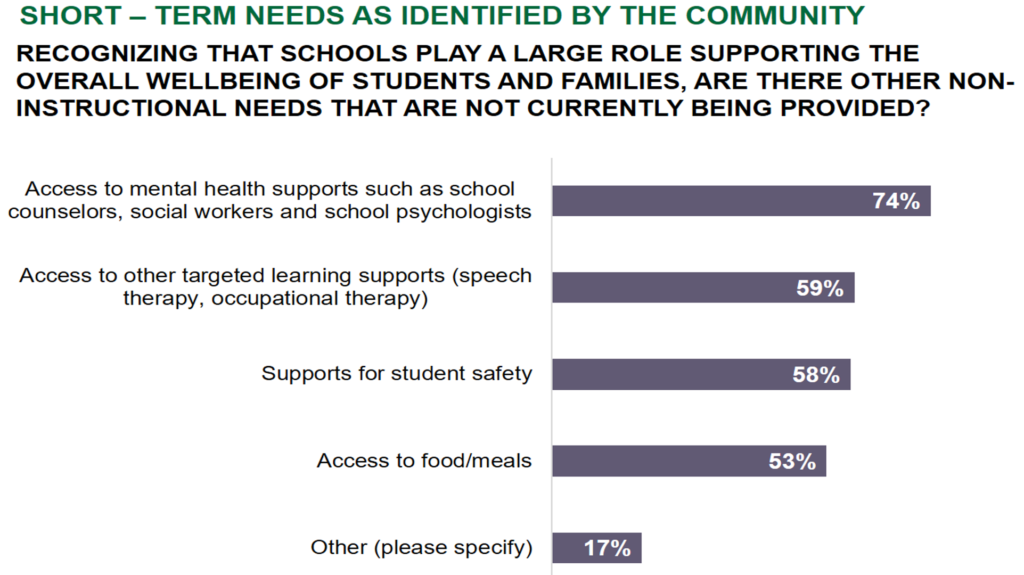
  • Access to mental health supports such as school counselors, social workers, and school psychologists (74% response)

Click here to explore the full findings. 
As many researchers and advocates have pointed out, students with special needs—including low-income students, English learners, students with disabilities, and those experiencing homelessness—are especially vulnerable during a prolonged emergency.

The survey aimed to gather information from the community so that Delaware’s philanthropic, nonprofit, business, advocacy, and government partners can better serve their constituents during and after the COVID-19 crisis.

“These are unprecedented times in public education,” said Rodel president and CEO Paul Herdman. “We have nearly 140,000 students in Delaware not attending traditional K–12 schools, and thousands more attempting to learn remotely from our early learning centers, our colleges and universities. If we do not act aggressively, the “gaps” in opportunity for our most vulnerable young people will become chasms. We risk losing a generation of young people if we don’t collectively listen and respond to the needs of our communities and educators.”
Most Delaware public schools shifted to remote, online learning by April, and they will operate this way for the remainder of the school year. By fall, many students will have gone the better part of six months without regularly scheduled, in-person coursework.

Forty-three percent of survey respondents identified themselves as classroom teachers, 18 percent identified themselves as parents, and more than 50 percent said they worked with either students with disabilities, low-income students, and/or English learners. This non-scientific survey was distributed through email and social media. Responses were collected between April 8 and April 22, almost four weeks after Gov. Carney’s initial Declaration of a State of Emergency on March 12.

The survey results illuminate challenges unique subsets of our population are facing. For instance, respondents who are serving English learner students said “access to certified English learner teachers, programs, tutors, and translator services” are a top priority. While those representing rural students said “access to consistent and reliable internet and transportation” is a key challenge. Survey results are organized by student sub-groups, as well as by county.

What Did Delaware Teachers Say?

  • “Having a difficult time getting families to consistently participate in the learning opportunities being provided. What is the expectation on the part of the teachers and families, and what is the best way to ensure that kids are getting the same opportunities?”​
  • “This Schoology thing is WAY too much and we have to do lessons. We hardly had training and I have tech issues daily. Either through parents or files not uploading and Zoom freezes during instruction.​”
  • “My neediest kids are not being helped at home. They have the Wi-Fi and the devices. They just don’t have an adult to work with them.​”


In Delaware:

  • 17% of households in Delaware don’t have access to internet
  • 9% of households do not have a device such as a computer, smartphone, or tablet
  • 83% of Delaware households access the Internet at home by paying a cell phone company or internet service provider (NCES Data based on Census, 2016)


State officials have urged families to contact their district or charter school to discuss internet and computer access needs. The state lists a number of free and low-cost internet options on its COVID-19 resources webpage. Some districts and charter schools are also providing families with technology to assist remote learning. Federal stimulus money as well as the support of DDOE and the Delaware Department of Technology and Information will help to increase access to internet access and devices across the state.

Districts and charter schools have developed remote learning plans that take into consideration students who may not have internet or computer access. For specific district and charter school plans, view the remote learning plans.

What’s Underway Now?

 Much of the immediate response effort focused on providing devices and meals to students, with some districts surpassing 100,000 meals served by mid-April. Districts and the state are also providing mindfulness and wellness supports; one example is DDOE’s partnership with Pure Edge for a 3-week webinar series for educators on Self-Care and Social and Emotional Learning.

Delaware districts use an online platform called Schoology, where educators post learning resources, assignments, and assessments—and communicate with students and families electronically, in addition to other tools.

What ideas did Delawareans share to meet the needs of public school students?

  • Social workers delivering school supplies and basic needs to families
  • Utilizing telehealth to deliver check-ups, meetings with medical professionals
  • Using whatever means necessary to connect with students, such as text messaging
  • Setting up social online activities for students
  • Creating a way for teachers to be in touch with students one-on-one while maintaining privacy
  • Leveraging specialists—teachers of music, art, library, and physical education—who aren’t as regularly connected with students
  • Drop-in online help sessions or Q&A opportunities for parents working with their children

What’s Next?

To view the full results of the community survey, visit this link.
Delaware Schools Persisting Through Covid-19 Pandemic

Governor Carney ordered all Delaware schools to remain closed through the remainder of the schoolyear to help fight the spread of COVID-19. Visit the state’s COVID-19 resource pages (schools and universities) for the most up-to-date and accurate state-level guidance for families, teachers, schools, and childcare programs, locations for free Wi-Fi, and more.


Click here to see Rodel’s compilation of COVID-19 news and resources. We are concerned about the inequities for children who are homeless, do not have adults who can help them learn remotely, who speak a language other than English, and who do not have access to basic needs or the internet during this time. The challenges are even greater when these children don’t have the stability and resources schools provide. We hope our recently completed community survey will help identify these needs and connect resources with those that need them.


The Delaware Campaign for Achievement Now has released a new database that compiles and compares district and charter school plans for distance learning during school closures. Click here to access the Delaware Distance Learning Plan Database.


In spite of the crisis and fragility of many students we serve, here is a look at what’s underway that gives us hope—and how Delawareans’ priorities for education are made even more urgent and clear by this crisis.


We have heroes among us—and we see promising practices and signs of hope around us.

Leading the Way on SEL: A Q&A with Lisa Mims


Lisa Mims has been at the forefront of some of Delaware’s most dynamic efforts around social and emotional learning. A longtime Rodel Teacher Council member and prolific ed-tech blogger, Mims currently takes part in the Compassionate Schools “Test Lab,” a model that trains teachers to find positive steps to calm students’ brains, build connections, and foster self-regulation skills.


We caught up with Lisa to hear her take on why SEL matters.


You gave an awesome TedX Talk last year in Wilmington. Tell us a little about your message.


My message was that nothing matters more than building a relationship with our students—all of our students. We especially need to build them with our students who might be a “little rough around the edges.” When we build relationships, more often than not, our students are willing to succeed because they do not feel as if we think less of them.


What do you see as the connection between school culture and climate and SEL? How does a strong, positive school culture support students’ SEL?


In a school where SEL is practiced, the relationship between the educators and the students is shaped by much more than test scores. The educators care for the students’ well-being and strive to create an atmosphere that feels more like a family atmosphere. Rather than penalizing students right away, the staff in the building attempt to find out the underlying causes and deal with situations from that standpoint instead of just determining that a child is “bad” or incapable. Students are very perceptive to how the educators feel about them and behaviors can be changed when students feel like someone cares.


Why is it so important to develop kids’ social and emotional side?


When we see our kids as test scores we are completely forgetting that they are children. Many of our students deal with things in their lives that would be hard for most adults to process, much less children. We have to take this into account whether we’re teaching them academics, or by building their resilience and developing tools to help them deal with whatever is going on in their lives.


There’s this strong link between SEL and trauma-informed care, and rightfully so. But SEL goes beyond supporting students in trauma, correct?


Yes, it does. SEL applies to all students, not just students who have suffered from trauma. All students need to learn how to manage their emotions, be empathetic to others, and be able to make decisions on their own. These are skills that will not only lead to a positive learning environment for all, but can follow them through the rest of their lives.


We’ve seen some great movement locally around SEL. What’s Delaware’s next big milestone? What’s on the horizon?


I know that the educators in the Rodel Teacher Council have made great strides in making districts and educators aware of SEL. At this time they are still meeting to further their cause. One top priority is working to make sure families and students have a voice in the creation of a statewide framework for SEL. Read Creating a Common Language for Social and Emotional Learning in Delaware, and learn more about the RTC’s work on SEL last year.


SEL is clearly something that’s very familiar and intimate with teachers and people inside education. But what should parents and the general public know about it?


Parents and the general public should know that it is not just another new thing. Kids are developing socially and emotionally in school and at home and wherever else they spend their time—the opportunity we have now is to make SEL a more intentional part of all classrooms and learning environments. When/if our students have a difficult time processing their emotions, it may lead to toxic relationships in the classroom, whether it’s with their peers or their teacher. Parents and the general public should know that we are aware that trauma and toxic stress are real, and not only are we finding a way to deal with and react to it, but we are giving our students tools to deal with it as well.


Read A Broader Vision of Student Success: Insights and Opportunities for Social and Emotional Learning in Delaware, which focuses on the efforts underway across Delaware to support students, families, and educators in developing their SEL skills.


Tell us about the Compassionate Schools “Test Lab”


Test Lab is a professional development opportunity extended through the Compassionate Schools partnership whose purpose is to work with teachers to find positive steps to calm student brains, build connections, and foster self-regulation skills. The hope is that these methods can improve student achievement, increase teacher satisfaction, and enhance the overall school climate. Such programs add value because they increase awareness of the impact of trauma and toxic stress on learning. They chose educators so that they could move from research to actual practice.

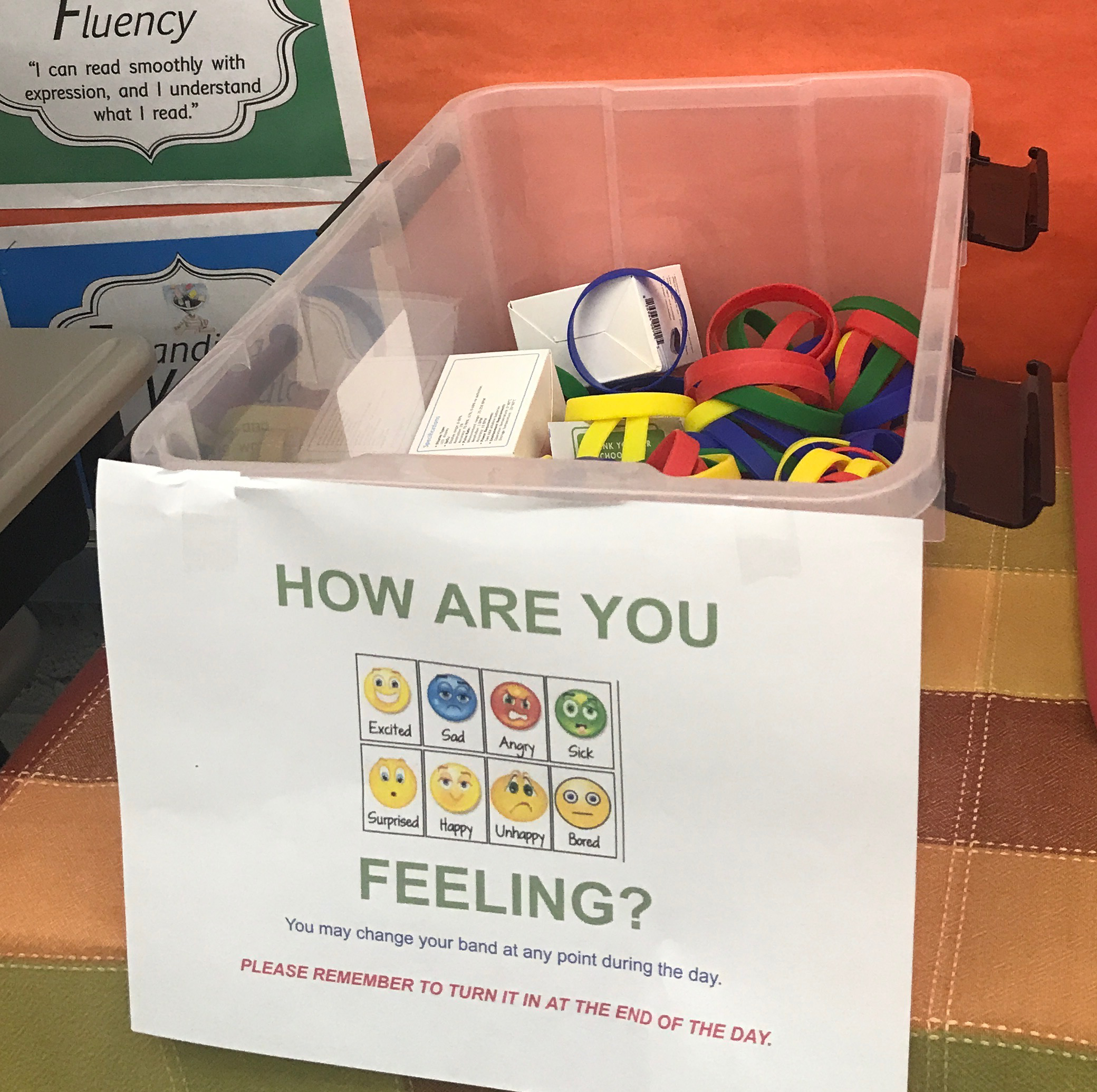
I was one of the educators fortunate enough to be chosen to participate. This semester, my students are using the self-regulation bands. The bands help them monitor their emotions according to colors, red, yellow, and blue. It’s amazing to watch them switch out the bands during the day according to how they are feeling. It definitely gives them ownership of their emotions. When we are done, we will share feedback with the lab and let them know how it worked (or didn’t), in our classrooms.

Blazing the Pathway on College and Career: Q&A with Paul Morris

Paul Morris is on the forefront of a slate of college-and-career efforts across Delaware, bringing his expertise on employer partnerships at the postsecondary to the K-12 world.

We talked to the associate vice president for workforce development at Delaware Tech about his very busy school year ahead.


Everyone knows about Delaware Technical Community College and the great things you guys provide in terms of career training for high school grads or adults continuing their education. But when did this notion of getting to kids while they’re still in high school first enter your radar?


Delaware Tech has been engaging school-aged youth for over 40 years in Delaware. The college has hosted numerous federal programs such as Upward Bound and Educational Talent Search, serving thousands of middle and high school students during that time period. We also interact with approximately 1,500 to 2,000 youth each summer and throughout the school year through our career, specialty, and sports camps. Lastly, over the past 10 years, we have partnered with all f the school districts within Delaware offering dual enrollment opportunities for students looking to earn college credits while in high school.


And what, specifically, is your role in Pathways and/or work-based learning?


Delaware Tech has been a key member of the Delaware Pathways team since its inception four years ago. Our high school advanced manufacturing program was the first pathway offered and was the model for the other pathways as it offered advanced college credits, meaningful work-based learning experiences, and portable credentials.

Delaware Tech is connected to every pathway currently offered through Delaware Pathways. Additionally, due to the college’s history with engaging and supporting employers in Delaware, we were chosen to perform the duties of intermediary for work-based learning from the onset. Within this role, we are responsible for operating the Office of Work-Based Learning, which engages employers, schools, and students to develop and deliver a continuum of work-based learning activities for students from seventh grade through the first two years of postsecondary education. The ultimate goal of these activities is to ensure our youth are both college and career ready upon graduation.


Why do you think Pathways has taken off in Delaware the way that it has?


Pathways meets two important but specific needs. First, it provides secondary school students with the opportunity to become both college and career ready upon graduation. Students have many opportunities through the program to engage with employers and professionals within their chosen career field to better prepare them for the workforce. Second, Pathways creates an employer engagement structure so that employers understand the benefits and can easily connect with qualified students who have an interest in their specific career area.


What are some of your favorite Pathways success stories you like to tell?


My favorite success story is about a young man named “Joe.” He came from a blue collar middle class family from New Castle. He was a superstar in the manufacturing program from day one. He excelled in the hands-on portion of the program and wanted to transition into working within the manufacturing industry upon graduation. Joe had a couple of opportunities for work once he graduated, but chose to accept an unpaid internship at a local company that he desired to work at long term. He did such a great job with that internship that the company offered him a contracting position. Due to his work ethic and long-term vision, he continued to excel and was recently hired directly by the company. He is doing great and is planning to continue his studies in a post-secondary program in his field.


There are a lot of efforts unfolding in the college and career-prep world. What are you most excited about here at the start of a new school year?


I’m most excited about the work we are doing within the Office of Work-Based Learning. We are building the framework so that thousands of Delaware students will have the opportunity to participate in meaningful work-based learning activities. These activities will range from awareness activities like visiting a company on a structured tour to immersion activities like a paid internship. These activities will assist students in making college and career decisions upon graduation. They will provide students with documented work experience to inform their resumes. These activities will also help Delaware companies build a much-needed pipeline of trained workers for the future.


What are Industry Councils and what will they do/accomplish?


Industry Councils are groups of individuals representing a specific industry convened to inform the educational and business communities on the trends, needs, and partnership opportunities within the industry. Typically, a council will have an executive committee that will meet quarterly and create sub-committees as needed. The executive committee will hold an annual public meeting where they will go over their annual report and engage with members of the public.


You get to engage with all sides of the equation, so to speak. What’s your go-to selling point for employers when it comes to WBL? How about for parents or high school students?


Engaging and partnering with Delaware Pathways and the Office of Work-Based Learning is a key strategy in building a sustainable pipeline of future trained workers. These types of partnerships allow companies to inform curriculum, build relationships with students, and develop working relationships with educational and training providers. Employers will have the ability to create a specific pipeline that will feed their hiring needs in the future.

Participating within Delaware Pathways and specifically work-based learning activities is a no-brainer for students. They will graduate high school with a defined career path and valuable work experience within their chosen industry. They will have an opportunity to earn industry- recognized credentials, college credits, and build work readiness and soft skills that will further enhance their ability to enter the workforce after graduation. Our ultimate goal is to ensure students are both college and career ready upon graduation.


Let’s say I’m a business owner and I’m interested. What do I do? What’s my first step?


The first step is to contact the Office of Work-Based Learning at:

The Office of Work-Based Learning

(302) 857-1651
cj.kuhn@dtcc.edu

www.delawarepathways.org/owbl