Study Recommends Major Updates to School Funding System: A Look at the AIR Report

Educators, researchers, and advocates have long agreed Delaware’s school funding formula is in need of updates and modernization.

Per the lawsuit brought by the ACLU of Delaware and Delawareans for Educational Opportunity, the American Institutes for Research (AIR) were contracted by the Department of Education to carry out an independent assessment of the Delaware school funding formula. AIR’s charge included conducting a full analysis of Delaware’s current system, presenting a comparison of Delaware’s system to that of similar states, and providing recommendations on how to improve Delaware’s funding formula to make it more equitable to all students.

In December 2023, the Delaware Department of Education in partnership with the Vision Coalition hosted an event for AIR to present its findings. The event, held at the Dover campus of Delaware Technical Community College, brought over 150 educators, students, parents and other Delawareans together to hear the results of the research. Watch a recording of the event here.

Explore the full report here.

Findings

Having greater student needs means that Delaware will likely need to invest greater resources than comparison states to achieve similar outcomes.Assessment of Delaware Public School Funding

AIR’s report examined Delaware’s system from several angles, including equity, adequacy, transparency, and flexibility.

Delaware spends marginally more on schools serving higher populations of low-income students; however, this positive relationship is largely achieved through higher spending for students with disabilities.

Overall, Delaware’s current formula does not do enough to support low-income students and multilingual learners. Delaware provides fewer financial resources and experienced teachers in schools with higher low-income and multilingual learner populations.

Delaware also has a higher relative concentration of low-income and multilingual learners compared to our neighboring states. Consequently, we will need to spend more than our neighbors to meet the same educational levels they achieve.

Delaware’s state funding formula largely inhibits local contributions to school funding. State funds, which make up the vast majority of overall education funding, aren’t enough to make up for the difference in local funding streams.

More flexibility and transparency is needed in the system. While the basic concept of Delaware’s unit-count system is fairly easy to understand, there are many layers of additional formulas, grants, and other funding streams that add complexity and inflexibility to the system.

How Does Delaware Compare to Other States?

Delaware’s unit system is atypical of how most states structure their systems for funding education. Many states, such as New Jersey and Maryland, use systems that allocate dollars to districts through student weights, accounting for both state and local revenue. A local share is then determined, varying across districts according to the capacity to raise revenue locally.Assessment of Delaware Public School Funding

The report compares Delaware’s school funding system to Maryland’s, New Jersey’s, Virginia’s and Pennsylvania’s. All of these states utilize foundation formulas that begin with a base per-pupil amount, then add multipliers for low-income, special education, or multilingual students.

All of the comparison states except for Virginia spend more on public education than Delaware. And all of them outperform Delaware on fourth- and eighth-grade math and reading benchmarks.

Methodology and Recommendations

AIR researchers utilized two different models to determine their goalposts for things like “adequacy” and “equity.” The Education Cost Model approach utilizes a formula combining a set of empirical factors to determine target per-pupil costs. The other approach is the Professional Judgment model, wherein experts estimated values of various cost factors and added them up to get a per-pupil cost. AIR utilized both methods (shortened to ECM and PJP) to create their recommendations.

(Read more about the group’s methodologies on pages five through seven here.)

Using these models, AIR researchers determined the financial bases and weights for a potential student-centered funding formula.

When viewed by district, the per-pupil increases recommended by the AIR report looks like this:

The report included eight key recommendations.

  1. Increase investment in Delaware’s public education
    1. Delaware would need to invest an additional $600 million to $1 billion to meet the recommended adequacy standards.
  2. Distribute more resources according to student need
    1. To bring all students up to the recommended adequacy standards, resources need to be distributed more equitably, specifically for students from low-income backgrounds and multilingual learners.
  3. Improve funding transparency
  4. Allow for more flexibility in how districts use funds
  5. Account for local capacity and address tax inequity
  6. Regularly reassess property values
    1. HB 62, signed into law in August 2023, implements rolling property reassessment every five years.
  7. Simplify the calculation of local share provided to charter schools
  8. Implement a weighted student funded (or foundation) formula


Stay up to date on resources and analysis collected by the Vision Coalition here.

What Did Federal COVID Funding Do for Delaware Schools?

Back in 2021, President Joe Biden’s $1.9 trillion American Rescue Plan Act, the third federal stimulus package launched in response to the COVID-19 pandemic, provided $350 billion for states, local governments, territories and tribal governments, with around $125 billion nationally earmarked for K-12 schools through the Elementary and Secondary School Emergency Relief (ESSER) funding stream.

Out of the $125 billion dollars in the ESSER I-III pots, Delaware received approximately $411 million. As written in the federal law, 10 percent of Delaware’s funding went to the state Department of Education (DDOE), and the remaining 90 percent went directly to Local Education Agencies (LEAs), otherwise known as districts and charter schools.

Two years later, it’s important to ask: Where did that money go?

Both the DDOE and LEAs were required to submit plans for spending the money (which in turn were required to be posted publicly). DDOE’s plan had to be approved by the U.S. Department of Education.

Here are a few key areas where the state of Delaware, districts and schools invested:

Broadband and digital learning. The pandemic underlined the importance of reliable internet connectivity for digital learning. In response, the Coronavirus Aid, Relief, and Economic Security (CARES) Act supplied funding dedicated to Connect Delaware, an initiative that brought free broadband connections to low-income households. Just last month, Gov. John Carney announced the ambitious goal of making Delaware the first state in the country to connect every home and business to high-speed internet.

 Delaware also saw statewide adoption among districts of an online learning management system called Schoology that allows students and families to stay plugged into classroom news and assignments—and a new online platform for quality teaching materials (Digital DE), plus access to an online reading platform, Sora, where kids can read from over 1 million books.

Updating aging school facilities. In 2020, DDOE reported an estimated $1.5 billion in deferred maintenance for public schools—from moldy buildings, to leaky roofs, and more. ESSER funding enabled the state to address many of those issues with over $13 million in renovations.

High-quality classroom materials. Since the pandemic, funding has enabled 76 percent of our schools to adopt high-quality instructional materials in English and math (up from 32 percent in 2019) and train staff to deliver them. To be considered “high-quality,” these materials must be vetted, and must be rigorous and knowledge-rich to guide instruction toward high standards.

For its efforts in this arena, Delaware received kudos and recognition from the Council of Chief State School Officers and Knowledge Matters.

Professional learning to support literacy. Literacy emerged as a critical focus area during and after the pandemic, especially in light of local and national data detailing COVID’s devastating toll on learning loss. Emergency funding will help provide all K-3 teachers with training in a certified body of literacy evidence known as the science of reading.

Renewed focus on summer programming. Keeping kids active and curious over summer helps accelerate learning, which has been especially important since the pandemic. DDOE works with districts, charter schools, Delaware agencies and community partners to develop initiatives and resources that keep students from falling further behind during this critical period. One example of how Delaware has come together to further empower students across the state is the Governor’s Summer Fellowship, which since 2022 has provided high school juniors and seniors with hands-on, paid work opportunities at summer camps in each county, on-site mentoring and also networking opportunities with state leaders. Students are gaining on-the-job experience, remaining active while school is on break and developing a deeper understanding of education, government and their communities.

Delaware’s other biggest spending categories include:

  • Education technology, including devices for students and online learning platforms: $57.6 million
  • Summer learning and learning loss, such as out of school time and tutoring with a focus on early literacy: $144.5 million
  • Mental health, such as additional staff and programming supports for students and staff: $8.9 million


Many of these efforts incorporated a braided-funding approach as needed to allow for program sustainability, ensuring the work would continue once federal funding receded. Strong partnerships with community-based organizations across the state have allowed funding to be used in new and innovative ways.

We still have plenty of work to do to support our students, teachers, and families, but we should be proud of the inroads we’ve made before, during, and after trying times.

School Funding Remains a Hot Topic in Delaware. Here’s Why

Momentum continues to grow in Delaware for an updated school funding system. And state officials continue to do more than is required by the high-stakes lawsuit that settled several years ago. Check out our recent blogs capturing the updates and progress underway pertaining to our funding system. 

Since then, much has happened: 

Budget Wins. In the still-to-be-passed state budget for Fiscal Year 2024, Governor Carney’s Opportunity Funding initiative—which provides extra support for every multilingual learner (MLL) or low-income student—will increase by $15 million, bringing the line item up to $53 million. This figure represents $3 million more than what is required by the funding lawsuit settlement. 

The RAND Corporation was contracted to undergo three studies on how Opportunity Funds are being spent. They found that funds are being used by schools on things that researchers recommend for improving student outcomes, including increased staffing, smaller class sizes and investments in wraparound and social-emotional services focused on MLLs and students from low-income backgrounds. 

Additionally, funding for Delaware’s Early Childhood Assistance Program (ECAP), the state-supported pre-K system, will double this upcoming fiscal year, expanding pre-K access to more families.  

Legislative Leadership. HS 1 for HB 33, a reintroduction of HS 1 for HB 144, would lower pre-K special education child-to-teacher ratios to align with K-three and four-12 grades as agreed upon by the lawsuit settlement, was funded in the Governor’s Recommended Budget.  

HB 62, a reintroduction of HB 252 from last year, would implement rolling property reassessment every five years to ensure that property taxes (from which school taxes are determined) are up to date and accurate. 

Student advocates from Cape Henlopen High School attended the March 17 Vision Coalition event on school funding.

Events and community engagement. On March 17, the Vision Coalition hosted an event focused on school funding with local and national experts, as well as over 100 members of the community, including non-profit leaders, educators, students, community leaders and others.  

Meanwhile, a recent survey of Delawareans conducted by the Local Journalism Initiative found that:  

  • The majority of respondents think that the state spends too little on improving the state’s education system (64 percent). 
  • Education and schools are considered to be a top issue for respondents. In fact, these are considered to be among the top five problems facing Delaware, with more respondents citing education and schools as a pressing problem than those who cited the unemployment and personal finances, the environment, transportation and infrastructure, housing and real estate, healthcare and insurance, and social issues.   

As the independent assessment being conducted by American Institutes for Research (AIR) continues to progress, the local community continues to be engaged and eager to learn more.  

The Vision Coalition will be holding a second installment of the Equity in Education series on June 12th at 1 p.m. on Why Money Matters in schools, with special guest Julien Lafortune of the Public Policy Institute at UC Berkeley. His research has found that increased funding over multiple years in K-12 education leads to higher test scores, graduation rates, college attendance and adult economic outcomes. His research has also found that how funding is targeted, to students, schools, or districts, matters for student outcomes.  Register for the webinar to learn more here. 

What to Make of the Small Jump in Delaware Public School Enrollment

At a Glance...

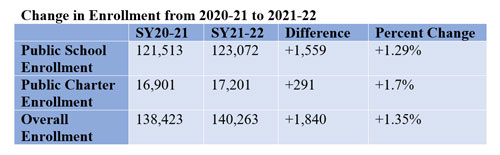
– School enrollment in the 2021-2022 school year increased 1.35 percent over the 2020-2021 school year, falling in line with pre-COVID averages.
-This follows Delaware’s first decrease in enrollment in a decade. Nationally, enrollment continues to sag.
-Enrollment directs essential budgeting decisions and policy considerations, especially in Delaware, which utilizes a “unit count” system to fund its schools.

As students head back to school, enrollment numbers and Delaware’s “unit count” begin to come into focus. Last year, we blogged about how the COVID-19 pandemic impacted enrollment in Delaware, and pointed out that in the 2020-21 school year, the state saw its first decline in public school enrollment in a decade—particularly in kindergarten and offset by increases in private and home school enrollment.

Enrollment is tied to essential budgeting decisions and policy considerations, so this decline was significant and concerning to policymakers and educators alike. In last year’s analysis, we saw that public district school enrollment declined, but public charter and non-public school enrollment increased, reversing trends we had seen prior. However, from 2020-21 to 2021-22, public school enrollment began to bounce back from the COVID hit, falling back into the pre-pandemic trend of enrollment increases.

National Context

Nationally, K-12 enrollment continues to decline. In the 2020-21 school year, the nationwide drop was roughly three percent. This overall decline continued into the 2021-22 school year.

There are nuances to this decline however, especially when you consider nationwide increases in pre-K and kindergarten enrollment. More detailed reports nationally from the 2021-22 school year are lacking, but experts are predicting a decline in enrollment for the next 10 years nationwide and are urging schools to consider their finances.

This decline can be linked to various factors, including parents choosing to enroll their students in non-public schools, a preference for virtual learning, schools’ COVID-related precautionary measures, but the most often cited reason is the “COVID baby bust” and the choice young adults are making to put off having children, or to not have children at all.

Delaware’s Numbers Heading into the 2022-23 School Year

The 2020-21 school year saw the first decline in enrollment in a decade in Delaware, a 1.7 percent decline. Typical annual increases pre-COVID were between 0.5 percent and 1.5 percent.

In 2021-22, when schools were transitioning back to fully in-person learning, enrollment rose, but remains roughly 2.5 percent behind where it would have been had pre-COVID trends continued.

Overall enrollment in the 2021-22 school year increased 1.35 percent over the 2020-21 school year, falling in line with the average increases year over year pre-COVID. As was seen in the national trends, kindergarten enrollment saw a drastic increase as well, roughly six percent over the prior year, putting kindergarten enrollment back at pre- COVID levels.

Why It Matters

  1. Enrollment and Funding: Enrollment directly affects the funding schools receive for the year. State funding for schools is driven by a count of student attendance in the fall, typically ending around September 30th each year. The state then uses this count to fund schools for the following year – and districts and charters use it to determine how many educators they can hire, which has been a challenge recently. Last year’s decrease in numbers was concerning for schools and their potential funding, but the increase this year could lift that pressure a little bit. This past legislative session also saw funding added for a mid-year unit count, allowing any additional students who enroll beyond that September 30th cut-off, but before January 30th , to be counted.
  2. Enrollment vs Attendance: While enrollment has increased, the question of how many students are actually attending is more difficult to count. The definition of “attendance” has been difficult to pin down throughout the pandemic. One measure is “chronic absenteeism” which is defined by the U.S. Department of Education as “students who have missed more than 15 days of school for any reason during one school year.”

Chronic absenteeism pre-pandemic (2018-19 school year) was the lowest it had been in the prior five years, at 13.24 percent, however, during the first two years of the pandemic, it increased significantly. The 2019-20 school year recorded an average of 15.68 percent of students chronically absent, and the 2020-21 school year had an average of 20.31 percent of students chronically absent.

It’s important to consider the various reasons why students may become chronically absent, and the various barriers and crises families faced due to the pandemic. These crises include: housing insecurity, mental health crises, internet access, technology access and other economic hardships. These barriers disproportionately affect minority students and students from low-income backgrounds.

  1. Delaware in the national context: Delaware is experiencing the opposite of the national trend of decreasing enrollment. The University of Delaware’s CADSR research center predicts growing enrollment continuing through 2040 in the state of Delaware. Still, we’d be wise to watch the predictive factors that may impact enrollment in the future, including birth rates and parent choices to enroll their students in homeschool or other non-public options, and how these factors may affect enrollment—and therefore funding—in the future.


These implications for Delaware’s overall school funding system must be considered in the upcoming assessment (as required by the lawsuit recently settled) as well as when relief funds run out and schools no longer have the funding they have been relying on for several years.