
Hybrid Funding System Begins Road to Implementation
– The Public Education Funding Commission (PEFC) is advancing a hybrid school funding model that blends Delaware’s current unit system with more flexible, student-centered funding.
– The proposal would simplify the formula, reduce prescribed staffing categories, and expand flexible funding aimed at meeting student needs—while protecting educator salaries.
– Local funding, reassessment, and equalization decisions remain unresolved and will shape the timeline and next phase of funding reform.

PEFC Moves Toward a Hybrid Funding Model
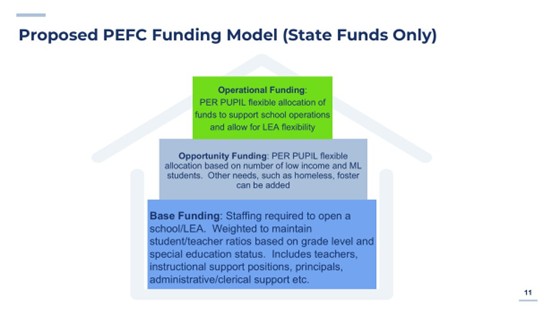
The proposed framework maintains a foundation of Delaware’s long-standing unit count formula but layers on student-based funding streams that allow districts greater flexibility in how dollars are used. The aim is to make the system simpler, clearer, and more responsive without disrupting core staffing structures.
At this stage, the proposal focuses on state funding. Questions around local funding and equalization—both critical pieces of the overall system—are still under review and will be addressed in future phases. There is also an investment in the Governor’s Recommended Budget of $2.8 million towards implementation of the new formula.
Key components of the model include:
- A More Streamlined Structure
The proposal reduces the number of state-prescribed unit positions from 32 to 18—a 44-percent decrease—giving districts more discretion to align staffing and resources with local needs. - More Student-Centered Funding
Flexible funding targeted to student needs would increase substantially, moving from roughly five percent of funding to about 30 percent. If adopted, this would represent a significant shift toward student-based flexibility. - Continued Protection for Salaries
Even with increased flexibility, the model maintains strong support for educator salaries and core staffing, reflecting a commitment to stability during transition.
Explore new informational resources from PEFC:
- PEFC Communication One-Pager
- Public Engagement Presentation (English) (en español) (an kreyòl ayisyen)
- Recorded Public Engagement Presentation
- Frequently Asked Questions (FAQs) (English) (en español) (an kreyòl ayisyen)
Timeline and Legislative Path
The commission’s work is ongoing, with planning underway to introduce legislation as early as April. Over the coming months, commissioners will continue refining the model, reviewing technical details, and incorporating public feedback before recommendations move forward. Legislation would signal a firm commitment toward implementation.
Public Engagement and Community Voice
Engagement with educators, community members, families, and students has remained central throughout the funding redesign process. PEFC has hosted multiple public engagement sessions aimed at gathering feedback and ensuring stakeholders understand how potential changes could affect students and schools.
Student voice has also played an important role in shaping the conversation, highlighting how funding decisions affect classroom experiences, opportunities, and supports.
In partnership with the Vision Coalition, community events have brought national perspectives and research-based insights into Delaware’s conversations about school funding . Legislative committee hearings have also provided opportunities for lawmakers and stakeholders to examine recommendations and raise questions.
Across these conversations, several themes have emerged: Delawareans are looking for a funding formula that is equitable, understandable, and flexible enough to meet the needs of diverse students and communities.
Related Developments: Reassessment and Equalization
Work on the funding formula continues alongside ongoing discussions about property reassessment and local wealth—issues that will ultimately influence how funding is shared across the state. Referendum reform has been a topic raised by legislators and districts for years, and another bill has been introduced to address it. Delaware is the only state that requires districts to go to referendum for any increases to the local component of general operating funds. Proposals in the past have included allowing a 10-percent revenue increase every five years, or two percent a year.
Reassessment hearings took place over the summer, with final numbers in New Castle County still being finalized. Those updates are expected to play a significant role in determining next steps for local funding and equalization. Appeals are still underway in all counties. Several bills were passed to temporarily alleviate stress on taxpayers, but more work will need to be done during this legislative session to fully smooth the process for future years.
Equalization work also continues, and policymakers are exploring whether the equalization committee’s responsibilities may be folded into PEFC moving forward. The PEFC is expected to address this before legislation is introduced.
Opportunities to Stay Engaged
Upcoming meeting:
- Public Education Funding Commission will meet:
- February 23
- March 16
- April 13
Click here for the agenda for the February 23 meeting. Community members are encouraged to give public comment, either by sending their name, organization and comment topic via email to Anna Sullivan (asulliv@wested.org); OR by raising their hand live during the meeting.
The months ahead will be critical as policymakers work to align funding structures with student needs, fiscal realities, and community priorities. Continued engagement from educators, families, and community members will help shape what comes next.
Related Topics: air report, delaware property tax, delaware school funding, federal education funding, pefc, public education funding commission, student success, vision coalition