
Difficult But Necessary Conversations Ahead on School Accountability

Delaware is considering changes to how schools are evaluated, supported, and held accountable for student outcomes. The Delaware Department of Education (DDOE) has proposed a School Performance and Support Framework that would establish clearer expectations for school improvement and a more structured system of state support and intervention.
The proposal comes as Delaware advances other major education reforms, including efforts to modernize its K–12 funding formula, strengthen early literacy, and improve statewide education and workforce data systems.
What Is Delaware’s Current Accountability System?
Under the federal Every Student Succeeds Act (ESSA), states must measure school performance, identify schools needing improvement, and provide support. Delaware uses the Delaware School Success Framework (DSSF) to evaluate schools, with results published annually through the Delaware Report Card. The DSSF measures school performance using indicators that vary by grade level:
- Elementary and middle schools: Academic proficiency in English language arts and mathematics (grades 3–8), student growth (grades 4–8), science and social studies achievement, and attendance.
- High schools: Academic proficiency, graduation rates, college and career readiness, ninth-grade on-track performance, and attendance.
- Across grade levels: Progress toward English language proficiency for English learners.
These measures also help to identify schools requiring additional support:
- Comprehensive Support and Improvement (CSI): Schools identified because of persistently low overall performance, low graduation rates, or failure to improve after receiving targeted support.
- Targeted Support and Improvement (TSI): Schools where specific student groups, such as students with disabilities or English learners, are consistently underperforming.
Currently, schools identified for CSI or TSI receive DDOE support, including technical assistance, improvement planning, and targeted resources. DDOE monitors progress of these schools against established improvement criteria annually.
The proposed framework would build on these existing requirements by identifying school needs earlier, defining increasingly intensive levels of support, and clarifying when additional state intervention may be necessary.
What Would the New Framework Change?
The proposed framework builds on existing requirements and establishes five tiers of increasingly intensive support:
- Universal Expectations: High-quality instruction and continuous improvement.
- Targeted Support: Additional assistance for specific performance challenges.
- Comprehensive Support: Coordinated improvement efforts for schools with significant needs.
- Directed State Intervention: Greater state involvement in school operations and improvement strategies.
- Receivership: Potential state-directed changes to school leadership or governance.
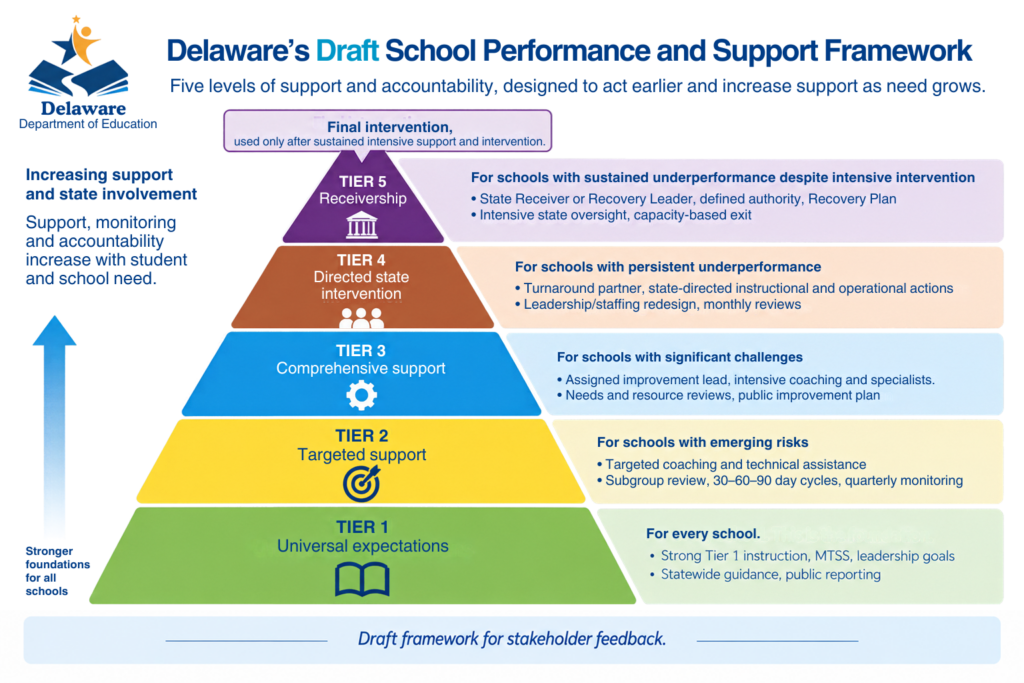
The framework also includes a separate early literacy component addressing screening, interventions, and third-grade promotion and retention.
Receivership is not a new concept in Delaware. During Governor Jack Markell’s administration (2009 – 2017), efforts to intervene in struggling Wilmington schools faced significant resistance from educators and districts. That experience highlights the importance of stakeholder engagement, clear expectations, and shared responsibility when considering more intensive interventions.
What Can Delaware Learn from Other States?
National research suggests that stronger state intervention alone does not guarantee improved student outcomes. Experiences across states offer important lessons:
- Massachusetts: State intervention in Lawrence Public Schools produced significant mathematics gains and more modest reading improvements, supported by expanded learning time, instructional changes, and targeted student supports.
- Tennessee: The state-run Achievement School District showed no statistically significant achievement gains relative to comparable schools after five years, while district-led Innovation Zones demonstrated positive results.
- Rhode Island: Research found limited improvement from mandated school turnaround interventions, with some schools implementing more interventions performing worse than comparable schools.
Research on third-grade retention policies in Mississippi, Ohio, and Michigan also highlights the importance of early interventions and instructional supports alongside promotion requirements. In short, when this has helped, schools have identified the students that need extra help and worked with them more intensively well before they got to the decision of being promoted (or not) to the fourth grade.
Together, these experiences suggest that clear accountability expectations must be matched with strong implementation, organizational capacity, and sustained support.
Rodel’s Position and Recommendations
Rodel supports the overall direction of the state’s proposed framework, particularly its emphasis on high-quality instruction, differentiated support, and shared accountability. In feedback to DDOE, Rodel identified three priorities:
- Strengthen district, charter, and state capacity. Expand the framework to assess and support district and charter leadership, including instructional systems, staffing, professional learning, and resource allocation. Ensure the state has the capacity to deliver on the system it’s envisioned.
- Clarify expectations and responsibilities. Establish transparent criteria for entering and exiting tiers, intervention timelines, available resources, and state and local responsibilities. Receivership should remain a time-limited measure of last resort.
- Establish a multiyear plan to align accountability with broader reforms. Consistent with the state’s larger strategic plan, this strand of work should be built into a more comprehensive change management strategy. To do this well will require funding for staff and systems, so it should be coordinated with the implementation of the state’s K–12 funding reform. To ensure educators and the public have a clear understanding of what success looks like, these changes should be aligned with DSSF modernization and education data improvements. And to ensure that the adults in the system know how to maximize this moment, the educators and administrators in our schools and districts will need training on how the new funding, accountability, and support systems will work. In short, given all the moving parts, we suggest the creation of a public, multiyear roadmap to align these new accountability expectations with resources and the capacity needed to meet them.
What’s Next?
DDOE is gathering stakeholder feedback through November 20 as it refines the proposal. Key questions remain about implementation timelines, resource commitments, intervention criteria, and potential legislative or regulatory changes.
Delaware has an opportunity to connect its work on school funding, accountability, and early literacy into a more coherent strategy for improving student outcomes. Rodel welcomes Secretary Marten’s commitment to treating this work as a “shared civic project” that engages partners and builds collective ownership.
We look forward to working with DDOE and other partners to translate these reforms into meaningful, sustained improvements for Delaware students.
Related Topics: air report, delaware property tax, delaware school accountability, delaware school funding, federal education funding, pefc, public education funding commission, student success, vision coalition