
Launching What’s Next: How Delaware Is Rewiring the Path from Classroom to Career
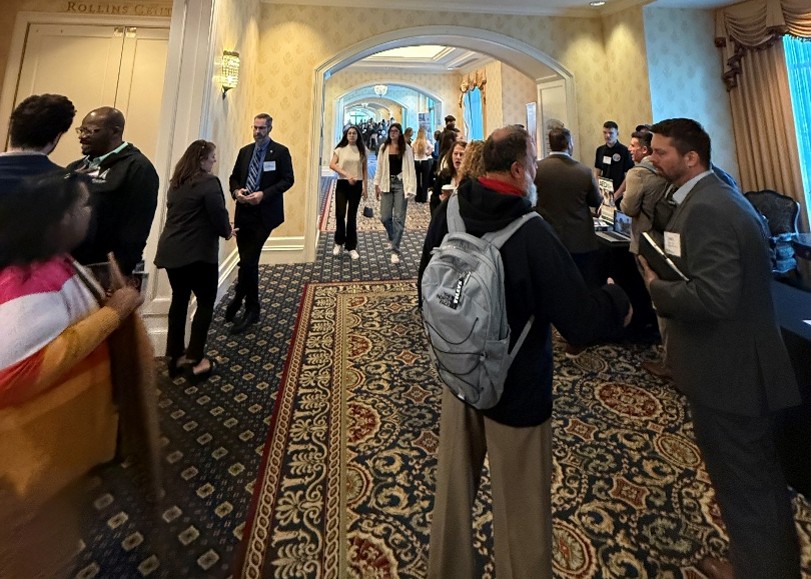
On a brisk April morning, during National Apprenticeship Week, over 400 Delawareans gathered in Dover for a day of reflection and energy around the state’s growing career pathways opportunities for students—but the real story has been building for years.
The Navigating Delaware’s Pathways Education and Workforce Development Summit, hosted by the Delaware State Chamber of Commerce, marked a major milestone—bringing together educators, employers, and policymakers to reflect on the system they’ve built together. It was a moment to step back and see the scale of Delaware’s work: a coordinated effort to ensure young people are prepared to launch their futures.
The energy in the building reflected our collective momentum—years of steady progress, growing alignment, and a shared commitment to ensuring that every Delaware student has access to a meaningful education and a clear path to a good job.
Click here to explore Small State, Big Vision: The Delaware Pathways Story.
Across the state, that vision is taking shape. Nearly 30,000 high school students, about 70 percent statewide, are engaged in career pathways that blend rigorous academics with postsecondary and work experiences. Students are earning college credit, gaining industry-recognized credentials, and participating in work-based learning that connects classroom lessons to future careers. Students are not choosing between college or a career—they are prepared for and are increasingly pursuing both.
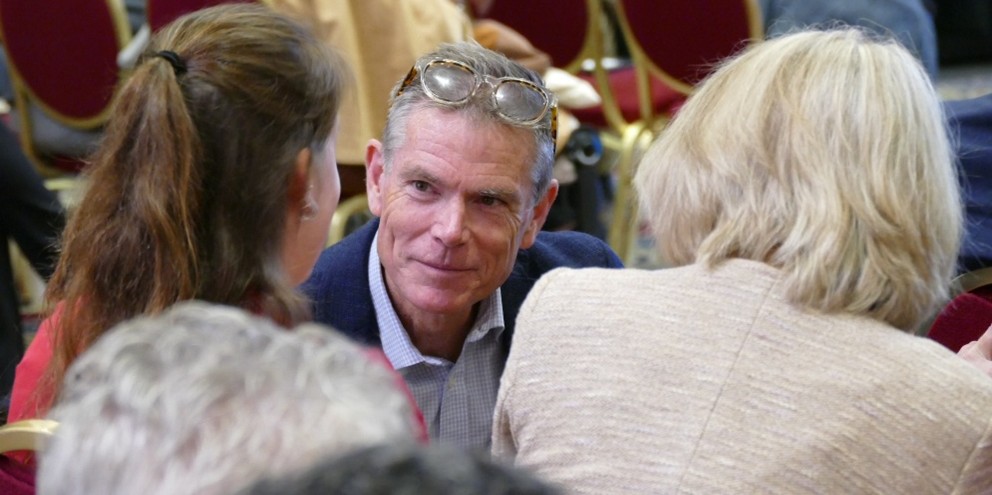
Paul Herdman, Rodel’s CEO, engaging conference participants on their career journeys.
Delaware now leads the nation in dual enrollment growth, with participation increasing by 44 percent in just the past two years. And more students are gaining access to the kinds of experiences that matter most: nearly half of pathway students currently participate in immersive, work-based learning.
Early outcomes suggest this approach is working. According to new research from RTI International, 74 percent of pathway graduates enroll in postsecondary education within six months, well above the national average of 63 percent, and nearly half choose a major aligned to their pathway. At the same time, 55 percent of graduates are working within six months, and many are gaining work experience while continuing their education. By 18 months, nearly seven in 10 graduates are employed, and the share balancing work and postsecondary education grows from 35 percent to 48 percent, reflecting a steady transition into the workforce.
Just as important, the number of students disconnected from either work or education drops from six percent to just two percent (within 18 months). The report also highlights the role that immersive work-based learning plays—reaching 46 percent of students—and how critical it can be in helping students connect their education to careers. This is especially evident in high-demand fields like healthcare, education, and the skilled trades, where students are increasingly pursuing aligned postsecondary pathways.
These insights give Delaware a clearer picture of how students are progressing in the first two years after high school, something most states cannot yet measure, and marks an important step forward. But this is just the beginning of the story we need to continue building.
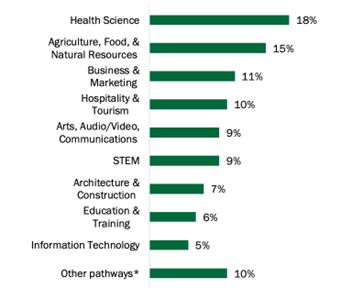
The bar graph above captures the distribution of Delaware’s pathways students relative to our high demand fields.
Just as telling are the stories behind the data. Students consistently point to hands-on experiences, mentorship from industry professionals, and the opportunity to explore careers as the most valuable parts of their education. Even when students decide not to pursue the field they studied in high school, that experience has value, helping them make more informed decisions about their futures and building durable skills like teamwork, time management, and problem-solving.
Read: Do career ‘pathways’ work? Delaware offers early clues from Hechinger Report.
By 2031, Georgetown University projects that 85 percent of good jobs will require education or training beyond high school. In Delaware, only about 64 percent of our workforce has a postsecondary credential. Closing that gap means acting with urgency and aligning systems to support both the next generation and today’s workforce.
We’re seeing that shift take hold. Registered apprenticeships, which pair private sector leadership with state support, are expanding—not just in traditional trades, but in fields like healthcare and education. Governor Matt Meyer has set an ambitious goal of growing apprenticeships to 3,000 annually, while new models are emerging that blend classroom learning with paid, on-the-job experience. We saw this illustrated during National Apprenticeship Week at an event held at POLYTECH School District, where research from Chmura highlights that apprenticeships have an 11.8 percent return on investment, graduates see more than a $20,000 wage increase, and 86 percent of graduates work in Delaware. That means that the proposed $1.5 million expansion of the state apprenticeship programs included in the governor’s recommended budget will see a more than $17.5 million return economically.
At the same time, employers know learning doesn’t stop at age 22. As AI and automation reshape jobs, continuous upskilling is becoming the baseline. For example, in healthcare, frontline roles now require ongoing training in digital records and diagnostics, while in manufacturing, workers are being retrained to operate advanced robotics. The takeaway is clear: the most competitive employers aren’t just hiring talent—they’re constantly shaping it. Delaware has a head start—and we’re building for what comes next. The state is in the process of expanding its longitudinal data system, which will help answer the questions every parent and policymaker asks: Are these pathways leading to good jobs? And are those jobs here in Delaware? For the first time, we will be able to connect the dots across K–12 education, higher education, and the workforce in a meaningful, transparent way. The state is also preparing for the rollout of Workforce Pell, which for the first time will make federal financial aid available to very short-term postsecondary training programs beginning this July.
And students and their families benefit from these efforts. Delaware has earned national recognition for expanding opportunity so that more students, regardless of background, can participate in high-quality pathways and the experiences that come with them.
System-level alignment is no longer the goal—it’s happening. Governor Meyer’s Executive Order 10 established the Office of Workforce Development, bringing together K–12, higher education, and workforce systems under a shared vision. Combined with major economic investments—from port expansion to the growth of the STAR Campus and companies like Merck, Delaware is positioning itself not just to prepare talent, but to keep it. But progress doesn’t mean the work is done.
If we want to fully realize the promise of pathways, it will take mutual accountability. It will take employer leadership, like John Gooden of M. Davis Construction has done, offering more than 100 high school students each year meaningful co-op experiences that help build both their futures and his company’s workforce. It will also take schools and higher education institutions continuing to listen to students and employers, and co-designing learning experiences that are relevant, rigorous, and inspiring.
It will also mean strengthening the “navigation” that helps students make informed choices along the way. As research continues to show, pathways are more powerful when they open doors for young people, but this means that students need to be prepared to walk through them, with informed choice and the ability to apply their skills in ways that reflect their education and career goals.
Delaware is already recognized as a national leader in this work. But leadership is not a destination—it’s a responsibility.
Our next chapter is about going further: expanding access to work-based learning, strengthening advising and support, scaling career exploration into the middle grades, and ensuring that every Delawarean—students and adults alike—has a clear, supported path to opportunity.
Related Topics: apprenticeships, career pathways, delaware pathways, registered apprenticeships