
Historic Session Ushers in New Funding Formula and Major Investments in Education
2026 Delaware Legislative Wrap-Up
153rd General Assembly, Second Session (2026)
The 2026 legislative session may be remembered as one of the most consequential for education in recent Delaware history. Years of advocacy, from Early Childhood Advocacy Day rallies and grassroots organizing efforts to public engagement around school funding reform, helped build momentum for change. The result was a session that delivered historic investments in Delaware’s early care and education system, making a down payment to address the state’s “literacy emergency,” and culminated in the adoption of a new public school funding framework, beginning the transition away from a system that had remained largely unchanged for more than eight decades.
This legislative session coincided with the second year of Gov. Matt Meyer’s administration, and where the first session was defined by transition, including new leadership, new cabinet, and the early stages of a literacy emergency, this session is defined by implementation and pressure: moving the Public Education Funding Commission’s (PEFC) recommendations into law, expanding access to early care, and doing all of it against a backdrop of significant federal funding uncertainty and actions that are deeply impacting children, families, and educators in Delaware.
Gov. Meyer and Sec. of Education Cindy Marten have aligned Delaware under a new strategic plan for education, which was released earlier this year, a response to advocates’ calls for expanded access to early care and funding system changes.
The end of this session also marks a time of major transition, as a handful of legislator retirements will mean at least nine new lawmakers will take office in January 2027.
Two retirements stand out in particular: Sen. David Sokola’s impact on Delaware education is hard to overstate. Sokola, who was first elected to the Delaware State Senate in November 1990, championed full-day kindergarten early in his career and went on to serve in leadership roles on the Senate Education Committee. He helped shape generations of education policy and remained a steadfast advocate for improving opportunities for Delaware students. As House Majority Leader and a longtime advocate for children and families, Rep. Deb Heffernan, who began serving her first term in January 2011, helped advance some of Delaware’s most significant family-support policies, including paid family and medical leave.
Their leadership and commitment to the well-being of Delaware’s children will have a lasting impact for years to come.
Where the FY27 Budget Landed
This budget and legislative cycle saw Gov. Matt Meyer and the Joint Finance Committee delivering on ambitious commitments to schools, students, and families. All told, Delaware increased its education budget by $92.9 million, a four-percent increase over last year’s budget, while adding dollars to enhance early learning statewide.
Early Childhood Education
- $8 million in one-time money for the Delaware Early Childhood Care & Education Alliance, an oversight committee spin-off of the The Interagency Resource Management Committee (IRMC), which will go toward state-sponsored pre-K expansions and infrastructure
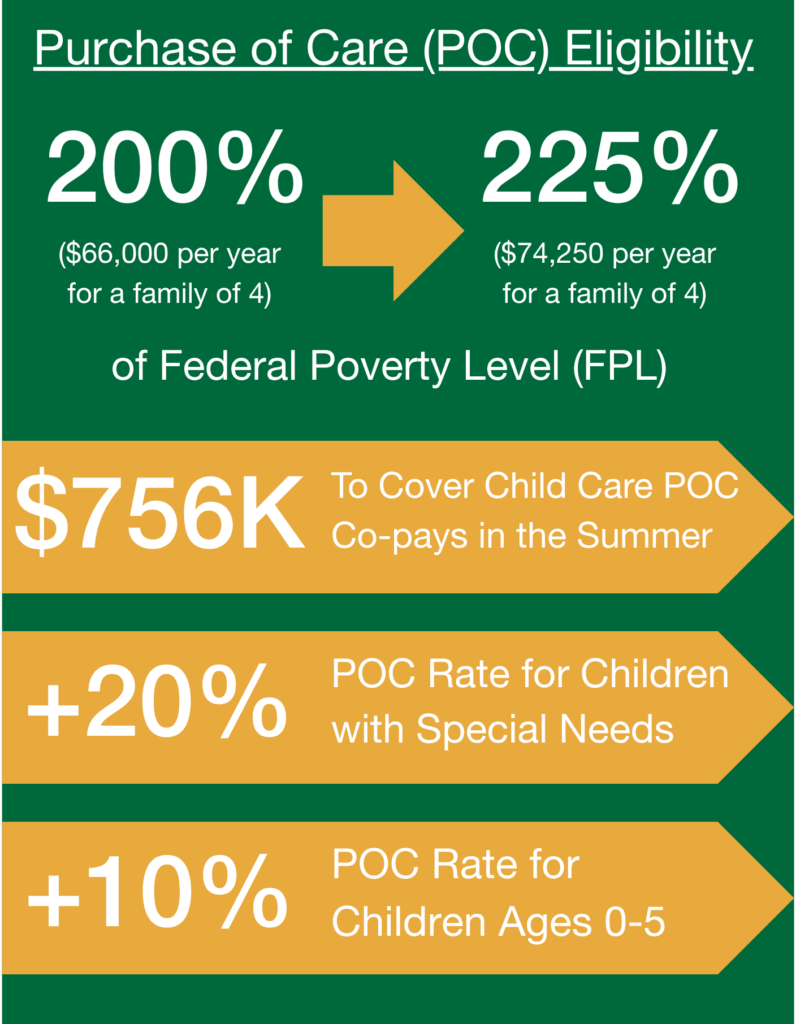
- $31 million for the Purchase of Care (POC) subsidy, bringing the total state funding commitment for this funding to $107,296,000 (up from $76.3 million in FY 26). These funds will be used for:
- A 10-percent increase in POC rates, helping providers give care for ages 0-5
- An increase in eligibility from 200 percent of the Federal Poverty Level (FPL) to 225 percent FPL, providing access for more families (benefits will now phase out from at 325 percent FPL instead of 300 percent).
- A special education rate of 20 percent more for children with special needs
- $756,000 to allow for families who qualify for and use part-time POC care to pay half the rate of what full-time families pay (3.5/seven percent of income for those 150percent FPL and above)
K-12 Investments
- $9.9 million to cover growth in student enrollment
- $100 million in one-time funding for hybrid funding model implementation
- $2.8 million in one-time funding for education funding reform system updates and training
- $68.9 million for year three of Public Education Compensation Committee to increase salaries 2 percent for educators
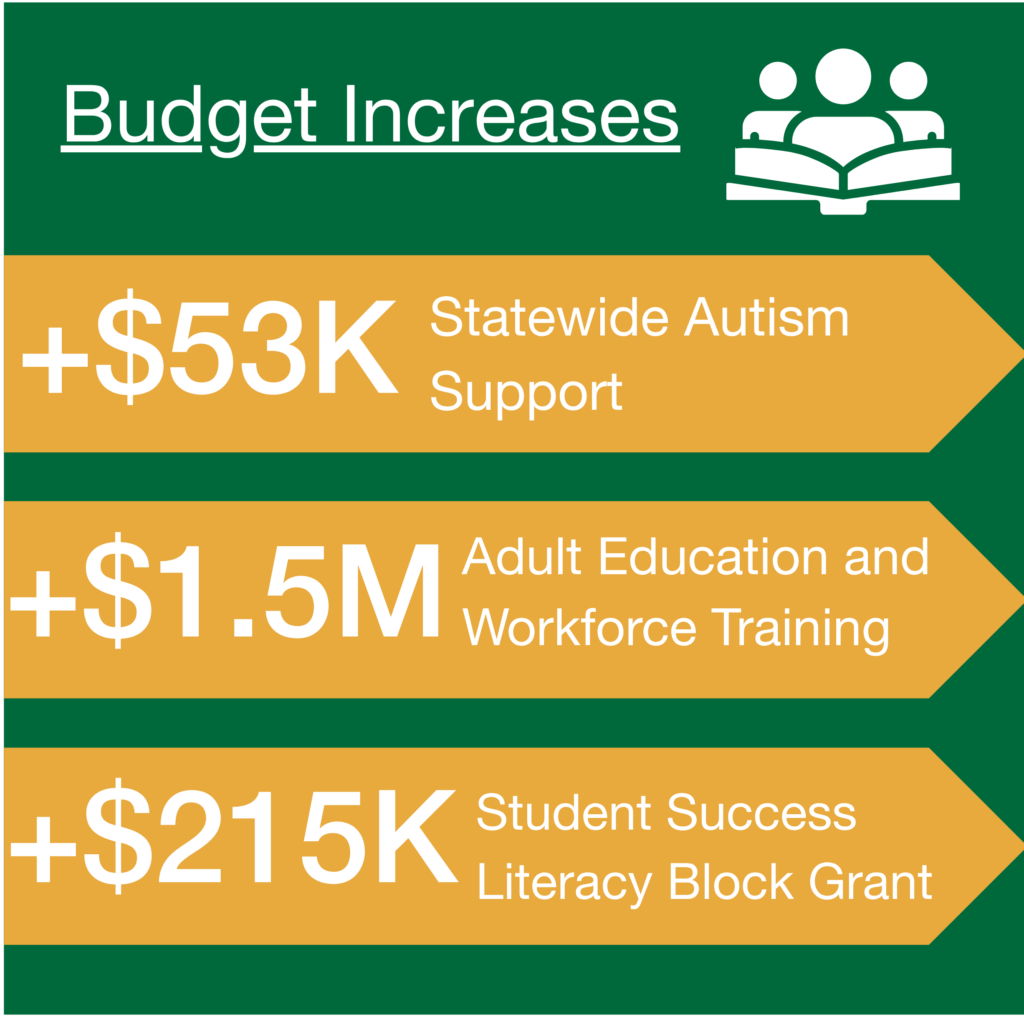
- $1.5 million to expand apprenticeships and workforce training for adult education at vocational-technical schools
- $3 million in one-time funding for teacher-driven projects, a continuation of the Your Voice, Your Choice initiative from Gov. Meyer in partnership with DonorsChoose
- $3 million restored in budget for Wilmington Learning Collaborative (WLC), adding to the total of $15.2 million between WLC and the Redding Consortium.
- $26 million restored in budget from FY18 Division II Unit Funding Cuts – Division II units support flexible operational costs and other costs associated with running school buildings (energy, maintenance, etc.)
- $3.4 million in one-time funding for SAT reform
- $87,500 for Teacher Academy scholarships, helping train the next generation of educators
- $206,000 for child care staff reclassification
- $255,000 for a Title IX coordinator position and technology
- $500,000 to fund salary supplements for national certifications for educators
- All substitute and athletic block grant/reimbursements restored
- Total increase: $92.9 million (four percent increase from last year)
Of note:
- No increase to Opportunity Funding (no increase in high-need student population)
- Mental Health Scholarship and Teacher Loan Forgiveness collapsed into “Public Educator Support Programs”
- $300,000 cut to Delaware Literacy Plan
Strong Bipartisan Support for Education Funding Reform
The defining legislative story of 2026 is the move to implement the Public Education Funding Commission’s recommendations. After years of advocacy and a deliberate commission process, the General Assembly took up the work of codifying a new, more equitable funding formula, while simultaneously grappling with the local funding disruptions caused by ongoing property reassessments across New Castle County.
“These bills are a step in reforming education in Delaware and ensuring outcomes that guarantee that our students become first-class citizens of the state, nation, and world,” testified Jack Young on Behalf of the Delaware League of Women Voters.
(To hear what Delaware students are saying about school funding, check out this recent blog.)
- SB 302 — Phase 1 of PEFC Hybrid Funding Model: Recognizes the PEFC’s recommended hybrid formula as sound policy and directs that implementation not be delayed.
- SB 303 — Codifying PEFC Recommendations: Formally codifies the commission’s framework into statute.
- SB 322 – Repeals the ability of school districts to increase tax rates by up to 10 percent when recalculating the district’s rate of taxation after a general reassessment, amending Title 14 of the Delaware Code relating to school taxes. Allows up to two percent annual increase in total revenue from local sources without going to referendum.
Continued Commitment to Early Care and Education
Early childhood education was among the most active areas of the 2026 session, with legislation addressing subsidy access, provider rates, summer care, health and safety, and a longer-range look at building a universal pre-K system. The central challenge remains the same: Delaware’s eligibility thresholds are among the lowest in the country, and even families earning minimum wage at two incomes can fall above the cutoff.
“High-quality early child education and care is one of the few public investments with decades of evidence showing measurable economic returns, especially when targeted well and aligned with K-12,” said Lynn Jones, the immediate past president of the Rotary Club of Wilmington.
“We need to think of early learning/child care as infrastructure, just like roads, hospitals, [and] schools,” echoed Debbie Taylor, a retired Delaware Department of Education early learning official.
(Wondering what Delaware can learn from other states? Give our blog a read.)
Access and Affordability
- HB 419 — Purchase of Care Eligibility for Foster Youth: Provides that a child is automatically eligible for Purchase of Care upon placement in foster care, amending Title 31 of the Delaware Code relating to eligibility for childcare assistance. This regulation was already in effect, but this bill codifies the policy.
- HB 447 — Childcare Affordability Planning: Directs the Interagency Resource Management Committee to coordinate planning, program development, and funding related to childcare affordability initiatives.
- HJR 10 — POC Rate Increase: Directs a 10-percent increase in POC reimbursement rates for children ages birth to five in FY27, across all settings.
Summer Care and Copayments
- SS1 for SB 278 — Summer Child Care and Copayment Reform: Requires that the Department of Health and Social Services (DHSS) regulations for Purchase of Care (POC) provide authorization for child care providers that children will attend during the summer starting January 1 so families can enroll before programs fill; aligns copayments with full/half-day care and household size.
- SB 293 — American Camp Association (ACA)-Accredited Youth Camps as POC Providers: Deems ACA-accredited camps as meeting equivalent health and safety requirements, expanding subsidized summer care options.
Health, Safety, and Oversight
- HB 259 — Lead Screenings: Requires child care facilities and schools to confirm lead screening for children 12 months and older before admission or continued enrollment.
- HB 312 — Lead Testing Methods: Updates confirmatory blood lead testing definitions to allow two capillary screenings as an alternative to venous testing, consistent with CDC standards.
- HB 438 — Amending Service Letter Validation: Adds the definition of child-serving entity for the purpose of requiring a service letter verification from any child-serving entity where an employee may have worked.
- HB 452 — DIAA Oversight: Expands DIAA and Background Checks for Child-Serving Entities.
- HS 1 for HB 47 — Background Checks for Child-Serving Entities: Removes the option for private schools and youth camps to use name-based checks; requires fingerprint-based SBI and FBI checks for all employees, contractors, and volunteers.
- HS 1 for HB 204 — Child Care Complaint Investigation Unit: Establishes a dedicated complaint investigation unit within the Office of Child Care Licensing.
Long-Term Planning
- HS 1 for HR 26 — Purchase of Care Program Reporting: Directs additional reporting by the Department of Health and Social Services to prepare reports on the Purchase of Care Program, building on House Resolution 14.
Support for the Educator Workforce and Impact
Building on a 2025 session that saw strong support for local educators, 2026 continued to focus on Delaware’s teacher pipeline, compensation, and working conditions, with new attention to parental leave, support staff wages, and the rights and safety of educators in the classroom. The state also committed investments to improve literacy, with $8 million to provide training for teachers statewide and $3 million dedicated to more than 4,000 teachers classrooms to improve literacy instruction.
(Hear perspectives from a student considering teaching as a profession: Rodel blog.)
Pipeline and Preparation
- HB 12 w/ HA 1 — Scholarships for Teacher Academy Graduates: Creates a one-time $2,500 scholarship for Delaware Teacher Academy graduates enrolling in a Delaware Educator Preparation Program, capped at 35 awards per year.
- HCR 131 — Mental Health Apprenticeships: Requests that DOL evaluate the feasibility of apprenticeship programs for school-based mental health professionals and submit a report by November 1, 2026.
Compensation and Working Conditions
- HB 262 — Parental Leave for School Employees: Clarifies and strengthens paid parental leave rights for school employees, including up to 12 weeks for birth or adoption of a child age six or younger.
- SB 231 — Social Worker Salaries: Provides school social workers who have passed national boards and hold a license with a salary increase.
- SB 279 – Occupational Therapist Pay Schedule: Clarifies pay schedule for school-based occupational therapists.
- SJR 14 — Workforce Data for Education Support Professionals: Directs the Delaware Department of Education (DDOE) to compile and report workforce data (by November 2026) for food service, transportation, custodial, clerical, security, IT, and paraeducator staff, including vacancies, average wages, and pay scales aligned with the MIT Living Wage Calculator.
- HS 1 for HB 425 — Increases the salary supplement for school counselors and school nurses from six percent to 12 percent upon national certification.
Increasing College, Career, and Postsecondary Access
Postsecondary access remained a priority in 2026, with continued movement on apprenticeships, scholarship reform, and expanding work-based learning pathways. Federal funding was secured, and DDOE and the Department of Labor are moving forward on growing and launching educator apprenticeship programs, including paraprofessional and high school youth apprenticeships, building on HB 51 from 2025.
(Learn Delaware’s Pathways Story: Small State, Big Vision and check out the latest Delaware Pathways Outcomes Study by RTI.)
- HB 263 — Apprenticeship Funding Administration: Shifts control of apprenticeship and training funds fully to the Department of Labor, removing DDOE from administering apprenticeship-related funding. Streamlines workforce development and is supported by DDOE.
- SJR 15 — SAT & State Accountability Framework: Directs the DOE to reevaluate the SAT as Delaware’s primary accountability measure, engage educators in modernizing the framework, and incorporate additional measures (College & Career Readiness, industry credentials, dual enrollment) — while keeping the SAT available for college access.
- SB 260 – Certificate of Arts Excellence: Establishes a statewide credential awarded by DDOE to high school students demonstrating achievement in dance, music, theater, media arts, or visual arts.
- HJR 13: Directs the Department of Labor, in collaboration with the Department of Education and the Department of Health and Social Services, to study the creation of a Delaware Healthcare Apprenticeship Degree Program that would place aspiring healthcare professionals in paid clinical positions in healthcare facilities while they complete the training and schooling necessary to become credentialed healthcare professionals.
Prioritizing Student and Family Wellbeing
From school safety to immigration protections to student discipline reform, 2026 legislation continued to reflect the whole-child focus that characterized last year’s session—alongside new urgency driven by the federal immigration enforcement climate.
Immigrant Students and Families
- HS 2 for HB 94 w/ HA 1 — Safe Spaces: Restricts state and local law enforcement from participating in federal civil immigration enforcement at sensitive locations including schools, churches, and healthcare facilities, except in exigent circumstances. Officers acting under an exigent circumstance must file a written report within 48 hours; reports are compiled into a biannual summary to the governor and General Assembly.
School Safety
- HB 256 — Safety Hotlines on Student ID Cards: Requires public schools serving grades seven through 12 that issue student ID cards to print specific public safety hotline and text numbers on both sides.
- SB 273 — Ballistic-Resistant School Safety Materials: Allows schools to meet safety requirements by using ballistic-resistant materials in key areas, making minor technical updates to align the law with Delaware’s drafting standards.
Discipline, Mental Health, and Student Support
- HB 264 – School Nurse Advisory Committee Membership: Adds a school nurse as a voting member of the Childhood Lead Poisoning Prevention Advisory Committee.
Governance, Transparency, and School Regulations
Following the school board controversies that prompted governance legislation in 2025, 2026 brought a quieter but steady set of regulatory updates—on cell phones, literacy reporting, charter school personnel records, and the administrative structure of education agencies.
- SB 106 w/ SA 2 & HA 2 — Cell Phone Policies: Requires every school district and charter school to adopt a student cell phone use policy with educator input, limiting use during instructional time. (Signed 3/12/26)
- HB 267 — Triannual Literacy Deficiency Reporting: Requires districts and charter schools to report two times per year (rather than annually) on students identified with potential reading deficiencies and the interventions being provided.
- SB 223 — Personnel Records Extended to Charter Schools: Updates DDOE regulations for personnel records to include charter schools.
- HB 313 — Codifying the Delaware Department of Services for Children, Youth and Their Families Education Unit: Formally establishes in law the already-existing Education Unit within Delaware Department of Services for Children, Youth and Their Families, including its staffing, pay, and operational structure.
- HB 347 — Flexible School Registration Documentation: Allows parents to use documents other than a birth certificate for school registration.
- HB 300 w/ HA 1 — DOE Title IX Coordinator: Establishes the position of a Title IX Coordinator for the DOE to assist in Title IX compliance for athletics in grades 6-12.
- HB 459 — Energy Drinks in Schools: Prohibits the sale of energy drinks on public middle and high school campuses during school hours or school events.
- HCR 144 — School Facility Repurposing: Requests strategic plans and a framework for the potential repurposing of underutilized public school facilities and state-owned buildings to meet community and workforce needs.
District Finance and Operations
After the first general property reassessment in over 20 years, Delawareans were concerned with steep increases in property tax bills. The General Assembly called a special session in August of 2026 to review and discuss potential solutions, particularly for New Castle County. As property taxes make up a significant part of district revenues, several bills were passed this year to support districts through this new landscape.
- HB 461 — School District Tax Rate Reset: Provides special authority to school districts in New Castle County to reset their tax rate for the 2026-2027 tax year.
- HB 462 — School District Tax Rate Authority: Continues the authority for non-vocational technical school districts in New Castle County to utilize a residential and non-residential tax rate for school tax purposes.
- HB 463 — School Tax Exemption Changes: Modifies exemptions from county taxation to reasonably reflect changes in property value and inflation, including for school taxes.
Bills That Didn’t Pass
- SB 294 — POC for Postsecondary Students: Extends POC eligibility to full-time students pursuing associate or bachelor’s degrees; excludes student financial aid from income calculations.
- HS 1 for HB 404 — Artificial Intelligence and Extended Reality in Schools Pilot Program: Establishes a 12-school pilot program to apply AI and XR integration in classrooms and provide participating schools with related technology and services.
- HB 358 — Elopement Guidelines for Students with IEPs and 504 Plans: Provides guidelines for schools on addressing elopement, or when a student leaves the campus without permission, mainly related to parent notification.
- HB 379 — Comprehensive School Discipline Improvement Program: Transfers oversight of the school discipline prevention grant program to DDOE and Delaware Department of Services for Children, Youth and Their Families jointly; expands eligible services to include restorative practices and mental health support.
- SCR 156 — Comprehensive Health Education Standards: Requests DDOE to develop a working group to support comprehensive health education standards and programming in all K–12 grades.
- SB 272 w/ SA 1 — Project Labor Agreements for School Construction: Requires school districts to use project labor agreements for certain public works projects that exceed specified cost thresholds.
Looking Ahead
When the time comes to actually implement Delaware’s new school funding system, the real test will begin with FY28 budgeting. Codifying the formula is one thing; funding it equitably, and managing the political pressures around local reassessments, is another. The General Assembly and Meyer Administration have shown commitment to funding the new formula through this years budget, with $2.8 million allocated for support setting up systems this year, and $100 million set aside for when implementation of the formula in the future.
And while the early learning community celebrated historic funding increases this year, the question of more significant investments for continued expansion to achieve the goal of 40 percent of children served in public programs by 2028 remains open. Gov. Meyer ran on a campaign of universal pre-K, and most other states that have made transformational investments have identified revenue sources and committed significant figures to early learning.
The 2026 legislative session will be remembered for real movement on K12 and early education, the most significant legislation being to finally shift our school funding system—after 80 years of inertia—to better reflect the needs of students. Now the challenge will be in building the funding system needed to ensure that the resources get to the students that need them the most and that they have the intended effect of elevating their achievement and their lives. As they rise, so do the communities in which we live.
…
Note: The 153rd General Assembly spans 2025–2026, with bills introduced in the first leg (2025) carrying over into the second leg, which runs January through June 30, 2026. Any bill not passed by June 30 must be refiled in the 154th General Assembly to be considered. For more information, check out the General Assembly’s Website, which includes resources such as How a Bill Becomes a Law, and Spotlight Delaware’s Delaware Explained: The 2026 General Assembly.
Related Topics: career pathways, Delaware education, Delaware legislature, early childhood education, legislative session, pre-k, teacher support